Ocular Optimization and Data Integrity: Why My Neural System Rejects Noise
Yesterday I underwent SMILE Pro + CXL eye surgery.
Originally I had considered SILK, but after reviewing the trade-offs I chose SMILE Pro for its stronger long-term corneal stability rather than faster short-term recovery.
In engineering terms, it felt like choosing a more robust architecture for one of the most important input sensors I rely on every day.
1. The Legacy System Failure: A Case Study in Friction
After the surgery I encountered a small but interesting system mismatch.
Despite the clinic using femtosecond laser technology, their administrative system could not process a simple 30,000 KRW refund digitally. Instead, they handed me thirty 1,000 KRW bills because, as they explained, the system did not support digital transfers.
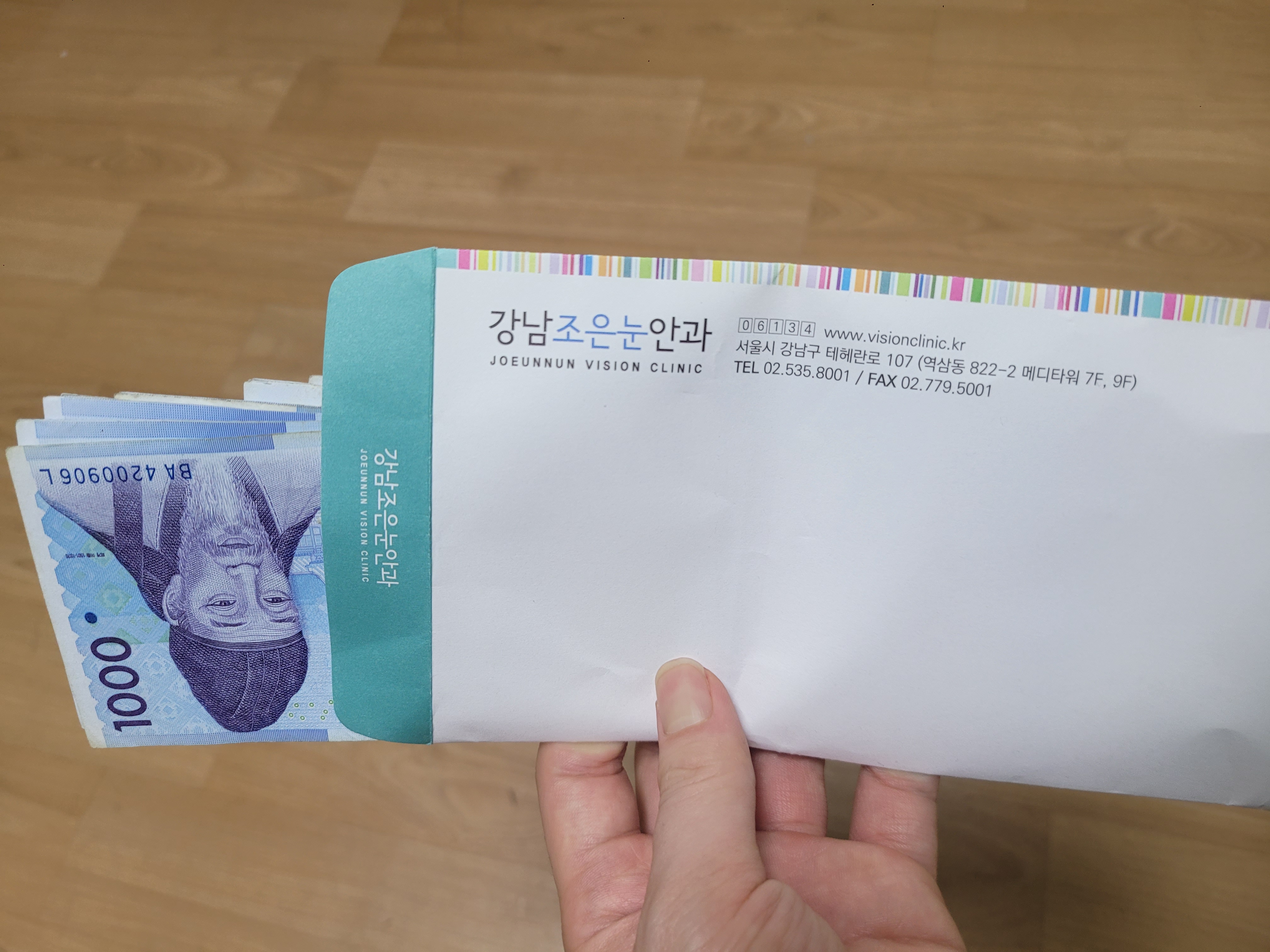
Thirty 1,000 KRW bills — a small artifact of a surprisingly analog administrative workflow.
This is a classic systems integration problem.
While the medical technology operates with extreme precision, the surrounding administrative infrastructure can still operate on legacy workflows.
Experiences like this make me increasingly interested in the “last mile” of system design — the layer where advanced technology must interact with real-world processes.
In healthcare, precision should not stop at the surgical equipment; it should extend across the entire system that surrounds it.
2. Hypersensitivity as a High-Resolution Signal
I have always been physically sensitive; even wearing contact lenses was uncomfortable for me. For a long time I thought this was simply an inconvenience.
Over time, however, I noticed that the same sensitivity appears in how I observe systems. I tend to notice small inconsistencies in environments or interfaces that others often overlook.
What initially felt like a weakness sometimes functions more like a high-resolution detector for noise — whether that noise appears in a physical system or a digital one.
3. From Dental “Slip Sheets” to Data Integrity in Forensic AI
This sensitivity to noise also shaped my attitude toward data integrity.
During dental school, clinical requirements were often documented through logs informally referred to as “Slip Sheets.” Occasionally I saw entries that appeared to be fabricated or reconstructed later.
My instinct was always to record observations exactly as they occurred. At the time I assumed this was simply stubbornness. Looking back, it reflected something deeper: once data becomes unreliable, the entire system built on it becomes questionable.
Today that principle guides my current project: dental_record_app, a system designed to structure dental records for forensic identification.
In forensic contexts, even a single dental data point can contribute to identifying an individual. Because of that, data reliability is not an abstract idea—it is fundamental to the credibility of the entire identification process.
4. System Status: Recovery
Today the bandage lens—the final temporary protective layer—was removed. My recovery has progressed smoothly and I have already been cleared to resume weight training.
Those thirty 1,000 KRW bills now sit at home as a small reminder that even highly advanced systems can still depend on surprisingly analog processes.
For me the lesson is simple:
technological progress only becomes meaningful when the entire system evolves together.
My long-term goal is to study computer science at MIT and explore how AI and structured medical data can improve forensic identification systems.
Note: This post was drafted with AI assistance (Gemini) to reduce screen time during post-operative recovery.
© 2026 Dong Jun Lee. All rights reserved.